A quick update on some swift comings and goings is due, so here we go!
First, thanks to Frank for his excellent update while I was away in the past couple of weeks. Frank’s contributions can go unnoticed to MCSI, but without his technical help, the emails and website would grind to a halt!
 So an update is needed. First to Dauphin. As ever, why write something yourself when others say it so much better. Over to Ken on July 8th:
‘Well, Jan and I decided to give tonight a chance to view the local swifts and decided to try a new observation location in hopes of watching all 3 chimneys but we ended up being too far away from two of them. We did see one exit from the roost chimney (#1) and some single entries but we were only able to see birds just as they went down. The #2 chimney (WAC) did have lots of interest but we only noted one enter. The #3 chimney was too far away and slightly obscured by a tree top so nothing to report there. At one time when they were flying around, we did count about a dozen swifts going between all 3 sites.’
Margaret and Millie had a busy pair certainly in the process of caring for young on the same evening in Brandon. This must be Manitoba’s most reliable breeding site (don’t tell St Adolphe).
We always look forward to John’s reports, primarily because he manages to check so many sites. John on July 10th had daytime activity at 139 Market and 41 Princess, both in Winnipeg.
Sticking in Winnipeg, Garry continues to watch his Watt Street sites, and they continue to be actively breeding. However, Frank, Jacquie and Cathy checked last night (the 11th), and only noted a single bird. Maybe the other one was in the chimney for the duration?
Sticking in East Kildonan, Lynnea successfully recorded the first use at Roxy’s Bowling on Henderson Highway on Wednesday evening. She noted at least one entry-exit cycle (last time I heard from a text, there surely is more to come here).
Rudolf made it an East Kildonan hat-trick:
‘I spent this evening (Wednesday 11 July) from 9:38 to 10 p.m. at the Northdale shopping centre. There was a single flyby at 9:38, then an entry at the Curtis Hotel at 9:42, followed by an entry at 1010 Brazier at 9:51. No exits were seen. By 10 it got too dark to see well, so I left.’
Tim failed to get out on wacky Wednesday due to jetlag, but he’s still been busy don’t you worry! On Tuesday he recorded first use of one of those old downtown sites in Winnipeg which has been on the database forever, a site at 172 Edmonton. This was on his walk home from the office. In a few minutes, 3 entries and a single exit were noted. This morning (Thursday), Tim also noted new sites at 526 Walker, and 33 Kennedy during his trip to work. The former included an exit, and the latter two entries.
Finally, a couple of nice stories to finish. Ken De Smet, our esteemed MCSI Steering Committee chair has located Chimney Swifts in Eriksdale, the first time MCSI has become aware of swifts in this part of the Interlake. A swift was noted entering a church on Railway Avenue, with a second bird in attendance.
Finally, Gerald has sent in some good news from Lockport:
‘This evening when we were returning from Winnipeg at about 8:15 PM I noticed a couple of Swifts near the bridge. So parked for a few minutes and saw several flying around. I saw up to 10 flying from 8:20 PM until 9:45 PM. Then they started going in and out of the north chimney. One came out of the south chimney. By 10:00PM only 2 were seen flying. Then it got a bit dark so I went home at about 10:10 PM.‘
Gerald has tried a number of times to locate swifts in this chimney, so it was great to finally track them down.
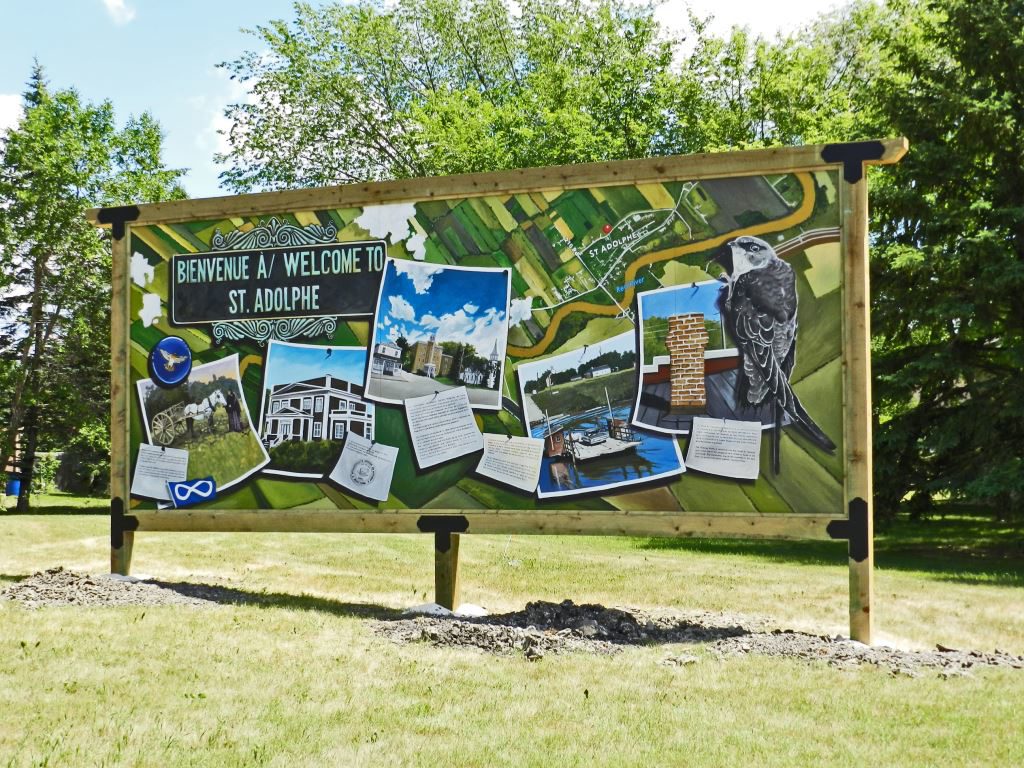
Before we forget, an update from Barb in St Adolphe:
‘Here is the St. Adolphe roundup for Wed. July 11:
Starting with Main St., where the swifts were no-shows for 90 minute sessions last Friday and then again Monday, aerial sightings were rare. Swifts were high up in the sky and were speeding by in the high winds. A pair left the chimney together about 15 minutes after the start of observations. After 60 minutes, no other entry/exit events took place. I left to carry on as the temperature was climbing fast, dragging the humidex rating along with it; the wind gusts of near 60 kph kept my chair awning blown down. It was tough to sit and watch with everything being tossed about but it was nothing compared to what those swifts were going through trying to feed! The Main St site was active today which is good, but the feeding rate was low.
At the Church over the noon hour, the occasional rain blob fell but nothing was substantial enough to change the activity patterns of the birds. As the clouds rolled in, the wind dropped, and then swifts started appearing low overhead to feed. Quite the reverse order of what happens typically in the course of a day. It took 100 minutes to capture some entry/exit intervals. A swift dropped into the chimney 85 and 91 minutes after the start of observations; they stayed at the nest site for ~12 and 6 minutes respectively as they left together. So despite seeing a lot of foraging swifts, the feeding rate was low at this site too.
Club Amical was the last stop for the day. Between 1:50 and 2:50 PM, a swift entered the SE chimney seconds after the start of observations and stayed for 1 minute. Shortly before the end of the session, 56 minutes later, 3 swifts came by and 1 entered the SE chimney, then 1 swift left ~20 seconds later. Were these partner exchanges or fast turnarounds by one swift? The feeding rate was higher (i.e., between-visit interval here was shorter) than for the Main St. and the Church sites. A longer session soon will help clarify whether a helper is on site at the SE Club and if the young are being brooded.
A pair of swifts entered the NE Club Amical chimney and stayed for ~17 minutes. They left together and were seen flying close together in the area afterward. A secondary attempt at nest building/egg laying seems to be indicated.
Still no activity at the Brodeur Bros. site after the June 30th nest failure.
One last note to watch for is the adults are starting to moult. Watching the trailing wing margin, you will see gaps or discontinuities where feathers are missing.’
 Always useful to get the full Barb interpretation!
Onto next Wednesday, and for this one a group of us will head south to check Emerson and maybe if we have a couple of extra folk around, another local town for swifts. Maybe a wild swift chase, but you never know if you never look! If you would like to come please let us know. For those living further away from Winnipeg, we have a great list of towns to check out, from Gilbert Plains, to Swan River, Fisher Branch to Pilot Mound. Let us know if you are interested in checking out a new place to look for swifts.
— Tim Poole

 We are in the midst of a potential housing crisis for some young swifts who have fallen from their nest. They have been re-placed in the nest, but they may not be re-visited and fed by their parents. (We’re monitoring the chimney now.).
 Wednesday 25th July
 We have been trying to keep volunteers and interested folk alike abreast of Chimney Swift activity throughout the summer. One of our target activities this year has been to go out and find swifts in new places. To this end, it is high time you were given an update as to where we stand on this, and a friendly reminder that there is still time to find more swifts.
 A huge thank you everyone who has gone out and checked these places. As you can tell, there are some places which need more looking to get those all important swift residences identified. Please feel free to go and find these, and if you need some pointers, we will be happy to help!
 An excellent
  This is everything updated for the moment apart from a summary of St Adolphe to come form Barb and a summary of a successful road trip to the south fromTim, Chris and Lynnea. We will also include a little update on progress of where we are with our searches of new towns. These will come over the next couple of days, so keep a look out! Otherwise thank you everyone for keeping your eyes to the skies!
 Post Canada Day greetings to all, and special thanks to the many volunteers who continue to brave the elements in search of sometimes elusive chimney swifts!
 Keep those monitoring reports coming in and feel free to assign yourself to a chimney of your choice on Swift Wednesdays!