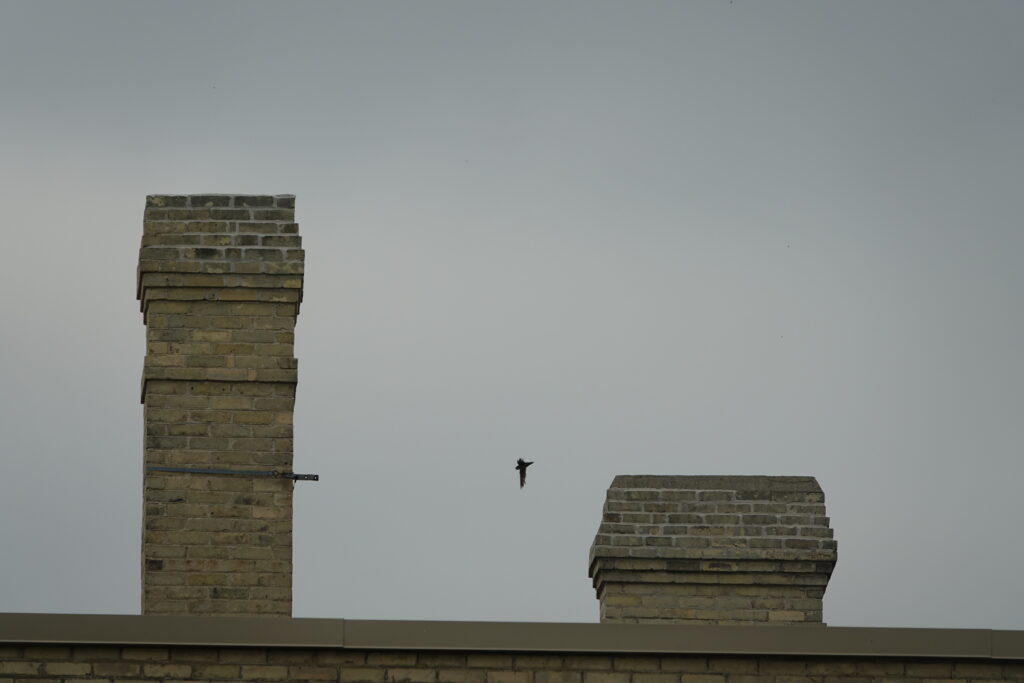
Hello everyone! I hope you’re all staying warm during this very chilly December. I wanted to make sure we wrapped up the 2025 Chimney Swift season before the New Year is upon us! One of my first tasks as MCSI coordinator has been to summarize this year’s data and I don’t think there could have been a better way for me to learn about the important sites across the province, and of course, the wonderful volunteers who dedicated so much time to monitoring in 2025!
This year we had over 95 volunteers monitor a total of 129 sites across Manitoba. We truly couldn’t run this program without you, so thank you for your time, your energy and your dedication to helping us learn more about Chimney Swifts in Manitoba. I’m looking forward to getting to know many of you during the 2026 monitoring season!
We’re always looking for feedback on your volunteer experience, what you liked, what you didn’t like, and any suggestions for us to improve. We have a volunteer feedback form at the following link: https://docs.google.com/forms/d/e/1FAIpQLSdlf7TgS8z9STs6lN6MHcjXtFhNtCOpIhTsHh8jzv31ZImLhg/viewform?usp=publish-editor You can leave your submissions anonymously or give us your name, whatever you’re most comfortable with! You can also email us with feedback at any time at mbchimneyswift@gmail.com
The Conclusion to the Infirmary Swift Saga
Before we get into the overall recap for 2025, I wanted to share the ending to the Infirmary swift story. Due to the coordinator changeover happening on our end, we left you on a bit of a cliffhanger. To recap: Dennis and Patti did an awesome job of keeping an eye on the Infirmary Chimney at the Selkirk Mental Health Centre well into September, hoping to catch a glimpse of fledglings. By their last monitoring session on September 14, there had been no sign of young swifts, and the adults had left for the season. At that point, we were unsure whether the nest had been a success, and the fledglings snuck away, or if it had failed.
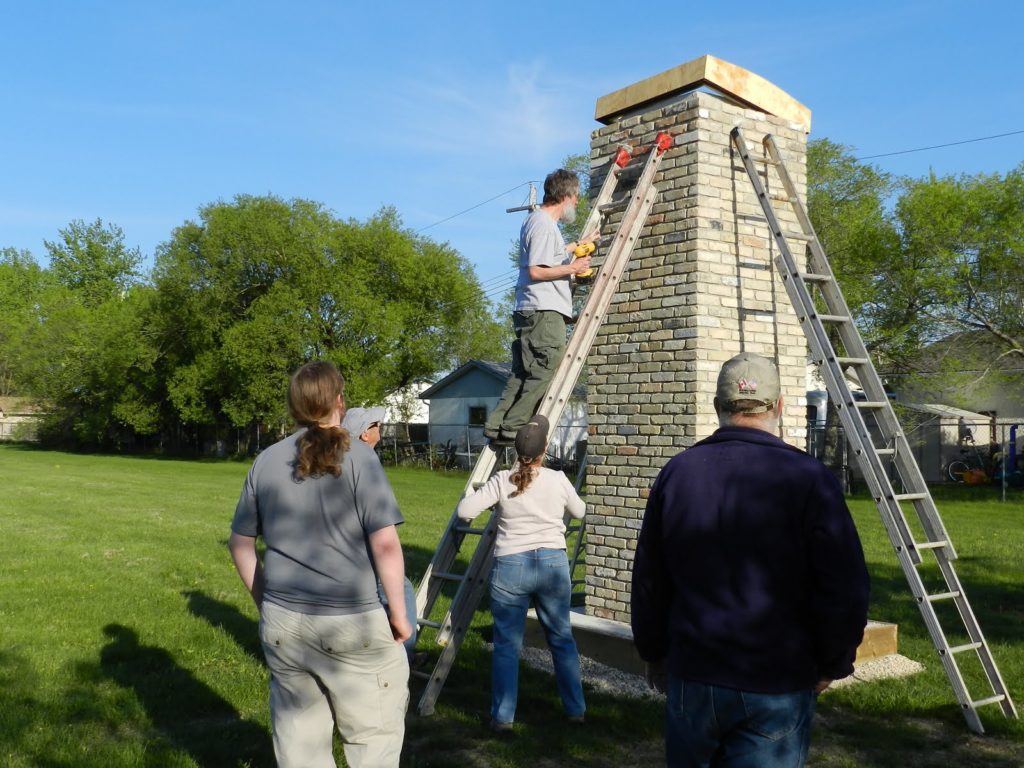
On September 25, Tim, Marissa, Kristine, Gerald, and several members of the Selkirk Birdwatchers Club completed the cleanout inspection of the Infirmary Chimney and all four towers at the SMHC. Results of the cleanout showed there were 2 successful breeding attempts, two breeding attempts that failed early in the season, and one that failed right at the very end. Here’s the summary from Tim:
Infirmary chimney – site hosted a large roost of 20 odd birds this year, so the guano pile was larger than usual. We pulled out parts of a broken nest. We were able to do a good inspection of the wall via a strong flashlight, mirror, and cameras and could not detect a nest on the wall, so presumably the broken nest on the ground was the nest used. Overall, there were enough eggshells for 5 eggs. These were interesting though. Around half (2-3 eggs) were very white, and half (2-3 eggs) were filthy dirty and dug out of the guano. It was as if a first nest had failed after hatching BUT we have no evidence to support that from monitoring, just a hunch. The second attempt was very late and failed around September 10th from the monitoring. That date was also around the time I had estimated that the birds should fledge. We pulled out three carcasses. One was larger and more decomposed – clearly an adult had died in the chimney earlier in the summer. Two others were almost fully grown, but the wings were clearly shorter than the adult. So sadly, there was a very, very late mortality of the two chicks just as they were due to take flight.
T1 Tower – the nest was down on the ground. That said, this was the fourth year and the fifth breeding attempt in that nest. 4-5 eggs all hatched, no carcasses. There were at least fledglings in a photo pulled from the camera inside the tower.
T2 Tower – had fledged, 5 eggs all hatched, no carcasses.
T3 Tower – ugh, this one is a doozy! 3-4 eggs all hatched, no carcass. Nest had fallen. Monitoring indicated early failure. The lens got gunked at some point so the photos became blurry. However, the photos were clear enough to show that the nest was on the wall on the morning of July 20th. However, at 7am there were two swifts (brooding?) at once. Later at 7:43am there was no nest on the wall. It had collapsed! Was this a switch over gone wrong or something else? After that there are still photos of swifts on the nest spot, suggesting a very strong fidelity for that spot (fledglings from 2024 maybe?).
T4 Tower – nest from 2024 had fallen (it was hanging off the wall in the spring). New nest on the wall on the west wall. You can see from the scarring that the nest was exactly the same height as the previous one but on a different wall. 4-5 eggs all hatched, no carcasses but monitoring indicated failure early on.
A sad ending to the Infirmary story, but as Tim said, “even with less than 50% success it still turned out to be an interesting year!”
2025 Monitoring Summary
With the Selkirk update out of the way, we can move on to what I know you’ve all been waiting for: the season summary. You can now find the updated MCSI Roost and Nest site database at https://www.mbchimneyswift.com/Documents/2025_data_summary.pdf. This document summarizes the peak Chimney Swift count (and the date on which it occurred) at each monitored site, and indicates whether each site was used as a roost or nest, based on the monitoring data available. This document also indicates if a nesting attempt was a success or a failure (if known).
Here are some highlights:
• We monitored 129 sites in 19 communities across Manitoba
• We confirmed the use of five new sites, all located in Winnipeg: the Manitoba MétisFederation Tower at 385 Henderson Hwy, St Edward the Confessor Church at 836 Arlington, a private residence on Maplewood Ave, Billy Mosienko Lanes at 1136 Main St, and a private residence on Hosmer Blvd.
• We confirmed the use of swifts at 14 sites on our priority list
• 95+ volunteers participated in our monitoring program, often in less than ideal hot and smokey weather conditions
• Historic first observation of a swift using a first-generation tower in St. Adolphe
We started the season with our second annual volunteer appreciation and kick-off event at Assiniboine Park on May 14, with a great turnout of around 30 people. It was a great way to kick off the season with some learning, some great food and prizes, and a group swift watch at the Assiniboine Park Zoo Tower.
As usual, we participated in the National Chimney Swift Roost Survey (frequently referred to as NRMP). This year, the NRMP nights took place on May 21, May 25, May 29, and June 2. By monitoring on these nights (with a focus on sites that host high counts of roosting swifts), we are able to contribute Manitoba data to this national effort. If you’re curious to learn more about this national program, you can visit the following webpage: https://www.canada.ca/en/environment-climate-change/services/bird-surveys/volunteers/national-chimney-swift-roost-survey-protocol.html On that webpage (in Appendix 3), you can find the annual dates for the 4 spring monitoring nights until 2031.
This year, we also organized monthly monitoring blitzes. Our blitzes took place on June 18, July 16, and August 19. While the spring NRMP nights are useful to know if a site is being used as a spring roost by swifts, we can’t necessarily tell that early on if a site will be used for a nesting attempt throughout the summer. These additional monitoring nights provided us with more information on when, where and how swifts use different sites.
Volunteers were free to monitor whenever worked for them throughout the season, whether that was on scheduled NRMP nights and/or monthly blitzes, or on different days if they were available. Some volunteers regularly monitored the same site, while others visited a variety of different sites to check for swift presence.
Thank you once again to our incredible network of volunteers.
I’d also like to extend a big thank you to the MCSI Steering Committee for their ongoing support:
Tim Poole, Barb Stewart, Rob Stewart, Frank Machovec, Christian Artuso, Lewis Cocks, Nicole Firlotte, Joanne Tuckwell, Ron Bazin, Ken De Smet, Stephen Petersen, Meredith Stoesz, and Kristin Mozel
To finish off this marathon of a season recap, I wanted to include the following message and illustration from Barb nicely summing up the importance of the work we all do here at MCSI:
An extra piece??? Usually, tabletop puzzles have missing pieces ~ ones that slip under the edge of a table mat or fall quietly on a carpet where the dog can enjoy eating them. But sometimes an extra piece creeps into the mix to challenge our problem-solving skill set.
Working with Chimney Swifts is an exercise in decoding a puzzle of sorts. A huge and complicated puzzle! By monitoring the birds, we patiently gather puzzle pieces and then try to fit them together. We reflect on patterns, edges (limits) and perspectives to frame the big picture. As time passes and the puzzle infilling continues, our understanding and knowledge of Chimney Swift biology in Manitoba deepens. Unlike finishing a tabletop puzzle, there seems to be no endpoint to understanding the complexities of Chimney Swift life. Those darn birds keep showing us intriguing insights that draw us into more rounds of puzzle solving.
Each and every puzzle piece generated by a volunteer monitor, who stares expectantly at a chimney rim, is a valuable component of the ongoing MCSI habitat stewardship, outreach and research programs. As the festive season transitions to a New Year, one to be filled with new chimney-side experiences, here’s a big shout out of appreciation to the volunteers who make MCSI such a success!
In 2026, our amazing volunteers will begin the 20th season of monitoring Chimney Swifts in Manitoba.
All of us at MCSI look forward to having you be part of that!
Thank you all again for an excellent season, I can’t wait to be a part of it in 2026. Wishing all of you a restful holiday seasonand a very happy New Year!
Mackenzie